
I recently came across a statistical phenomenon which I was not aware of. Admittedly, statistics was not my main scientific interest. But this should be an old problem. The idea was presented in a video by Sohil Rathi on Youtube without any further citations. I had to ask ChatGPT which found a blog posting by Dhirendra Kumar containing the exact same version of the problem. The basic idea of these studies go back to the Bernoullis cerntainly. However, I think this is interesting enough to be explained in more details with experiments in Euler Math Toolbox.
You play the following game: You are given a depot of money. Then you bet all the money on dice throws. If you win, you gain 50%, and if you lose, you lose 40%. You do this over and over again, many times.
It is immediately clear that the expected gain is 5%. Thus your expected win growth exponentially with a rate of 1.05. For an extreme example, you expect
1.05^{100} \approx 131times your starting amount after 100 games. But what if I told you that you are far more likely to have lost all your money after 100 rounds. That is the paradox we want to discuss. Why does this happen?
The simple explanation is, of course, that a minority will gain a lot of money, and the vast majority will gain nothing. The distribution of the money at the end is unbalanced, and that gets worse the longer you play. Due to this fact, this paradox plays a role in understanding risk management.
Here is the simulation in Euler Math Toolbox. It shows that after 100 rounds, only 13.6% have more than what they started with.
   A Paradox in Statistics

   You get an amount of money and bet everything on dice throws. If you
   win, the amount increases by 50%, if you lose, it decreases by 40%.

   Let us play 5 rounds twice.
  >N = 2;
  >A = intrandom(N,5,2)-1
                 1             0             1             0             1
                 0             0             0             0             1
  >A = 0.9*A+0.6
               1.5           0.6           1.5           0.6           1.5
               0.6           0.6           0.6           0.6           1.5
  >prod(A)
             1.215
            0.1944
   Paradoxically, the expected amout of money increases by a factor of
   1.05 win each row. Yet, you are very likely to lose all your money in
   the long run.

   Here is a simulation.
  >function simul (N,n) ...
  $  res = zeros(1,N);
  $  for i=1 to N;
  $     A = 0.6 + 0.9 * (intrandom(1,n,2)-1);
  $     res[i] = prod(A);
  $  end;
  $  return res;
  $  endfunction
   We simulate 10 rounds a million times.
  >N = 1000000; n = 10;
  >A = simul(N,n);
  >mean(A), 1.05^n
     1.62605723179
     1.62889462678
   In these 10 rounds about 2/3 will have less than when they started.
  >sum(A>1)
     376227
   This number gets worse with more rounds.
  >N = 1000000; n=100;
  >A = simul(N,n);
  >sum(A>1)
     136040
This gets worse with even more rounds. After 1000 rounds, I found only 0.01% who kept their money.
How can we explain this in mathematical form? The idea, due to Bernoulli, is talking about the logarithmic value of money. This viewpoint seems to be the psychologically more appropriate way anyway. Doubling what we have feels the same, however much we already have.
If we do this, we see that the logarithm of the amount of money we have changes in each step on average by
\frac12 (\log(1.5) + \log(0.6)) = \frac12 \log(0.9) \approx -0.052 < 0
Thus the expected logarithm of what you have tends to minus infinity. Because we have a simple binomial experiment in front of us, the expected mean and standard deviation are well known.
m(n) = \frac{n}2 \log(0.9) \approx -0.052\,n, \quad d(n) = \frac{\log(1.5)-\log(0.6)}2 \sqrt{n} \approx 0.66 \, \sqrt{n}. After enough rounds, the expected mean is negative enough to exceed the standard deviation multiple times, and it is very unlikely to find a logarithmic value greater than 0 in the results, i.e., a real value greater than 1. Here is a plot of the logarithmic distribution after 1000 rounds.
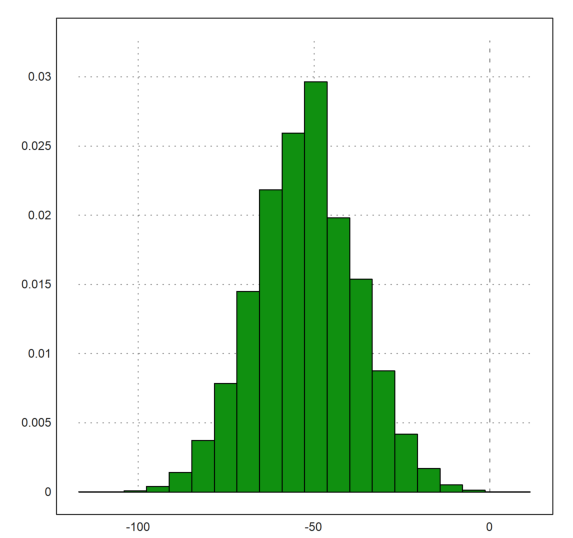
There is a way to avoid this disaster if the rules allow. You must not bid all your money every time. the best strategy is to bid only 1/4. You always keep 3/4 of your money, and put only 1/4 at risk.
This changes the logarithmic progress to the slightly positive side.
\frac12 (\log(3/4+1.5/4) + \log(3/4+0.6/4)) \approx 0.0062 > 0